



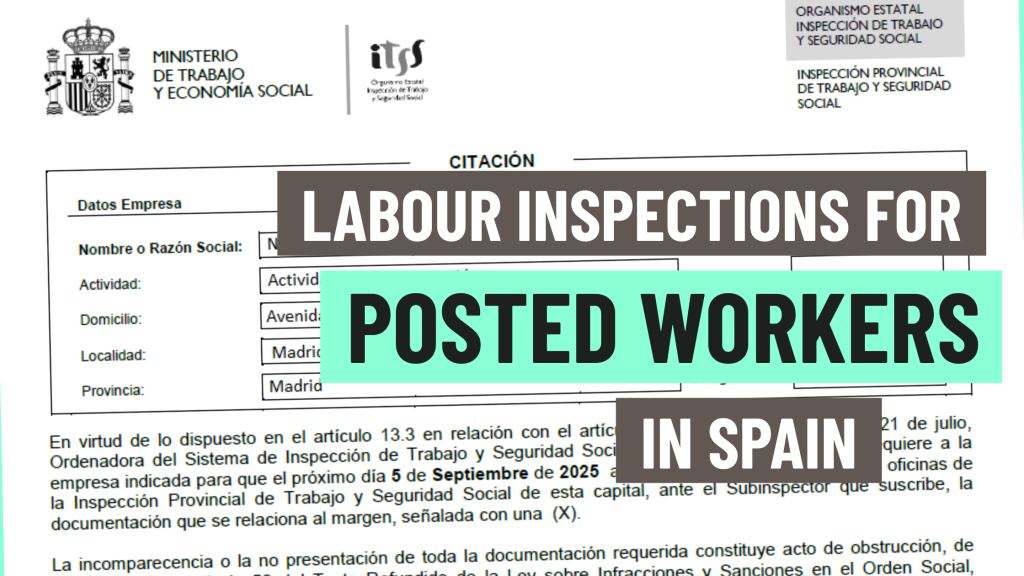
Foreign companies that post their employees to Spain to carry out construction projects are subject to inspections by the Labour and Social Security Inspectorate. Posted workers inspections have a clear objective: to verify compliance with Spanish labour regulations as well as occupational health and safety requirements.
These inspections are particularly common in the construction sector, where authorities regularly monitor working conditions, employment status and compliance with safety regulations.
Why posted workers inspections may take place
Posted workers inspections carried out by the Spanish labour authorities are not always random. Several situations may trigger an inspection, including the following common cases:
- Routine inspections on construction sites, as this sector is considered high risk.
- Specific inspection campaigns organised by the labour authorities in certain sectors or periods.
- Complaints submitted by employees, trade unions or third parties.
- Workplace accidents, especially those resulting in sick leave, hospitalisation or serious injury.
- Doubts regarding the legality of worker posting or registration in the Accredited Companies Register (REA).
- Cooperation between Spanish authorities and administrative bodies from other countries in the context of cross-border monitoring of companies posting workers.
In all cases, labour inspectors have the authority to request documentation and visit the construction site to verify compliance with Spanish regulations.
How inspections are carried out
Labour inspections may take place in two different ways.
- Direct inspections, where an inspector visits the construction site in person to check documentation and verify safety conditions.
- Electronic inspections, which are becoming increasingly common. In these cases, companies may submit the requested documentation by email or through dedicated digital platforms.
In most cases, submitting documentation electronically is sufficient. However, in certain situations the inspector may require the company or its representative to appear in person, especially when the authorities need to better understand the structure and operations of the foreign company.
Obligations towards posted workers
In addition to occupational health and safety documentation, foreign companies posting workers to Spain must comply with several employment and social security obligations that may also be subject to inspection.
These include:
- Possessing an A1 certificate for each employee, confirming that social security contributions continue to be paid in the home country.
- Having valid work permits for employees in their country of origin.
- Compliance with the Spanish Workers’ Statute and, where applicable, the relevant collective agreement regarding:
Salary in accordance with Spanish regulations and the applicable collective agreement.
Proper employment arrangements.
Paid annual leave.
Maximum daily and annual working hours.
Daily working time records.
Equal treatment of women and men.
Compliance with occupational health and safety regulations.
Timely payment of social security contributions.
- Respecting the subcontracting chain and ensuring that collaborating companies also comply with applicable regulations.
All documentation should be organised, easily accessible and, where necessary, available in digital format translated into Spanish.
Posted workers inspections – what documentation must be prepared
During a posted workers inspection, labour inspectors may request a wide range of documents related to workplace safety, construction site organisation and the legal status of the company.
The most frequently required documents include:
- Notification of the opening of the workplace.
- List of designated employees or confirmation of an internal or external occupational health and safety service.
- Initial risk assessment or, in the case of construction projects, the safety and health plan for the inspected site.
- Safety and health plan together with its approval document.
- Preventive activity planning.
- Construction safety study or basic safety study.
- Emergency and evacuation plan (Article 20 of the Occupational Risk Prevention Law).
- Occupational health and safety training and information.
- Documentation related to workers’ health surveillance (Article 22 of the Occupational Risk Prevention Law).
- Subcontracting book.
- Confirmation of the provision of personal protective equipment (PPE).
- Instruction manual and CE certificate for the lifeline system used on the construction site.
- Instruction manual and CE certificate for fall protection devices together with records of periodic inspections.
- Commercial contract for the execution of works.
- Declaration of adherence to the safety and health plan.
- All documentation should be available in Spanish.
Conclusion
Proper preparation of documentation is essential to successfully pass an inspection without complications. Although posted workers inspections are often resolved electronically, foreign companies operating in the Spanish construction sector should ensure that all documents are organised, up to date and translated into Spanish.
This not only facilitates the work of the labour inspectorate but also helps guarantee legal security and continuity of operations on the construction site.
More information can be found on the official website of the Spanish Labour Inspectorate: https://www.mites.gob.es/itss/web/index.html